

The 28 Most Asked Questions We Get About Direct Mail Fundraising
Expert answers to 28 direct mail fundraising questions: response rates, ask strings, segmentation, lapsed donors, newsletters, timing, and ROI
Most experts recommend sending direct mail appeals four or more times per year, with a printed donor impact newsletter or postcard between each appeal, and multiple donor impact emails (target 2 per month). Smaller organizations just building their direct mail program may start out with Spring and End of Year appeals and add additional as they grow their funding.
- The evidence is that when you add a second, third, fourth, or even fifth ask during the year, you increase annual retention, and the total net raised goes up. Contrary to what some inexperienced direct response fundraisers think, that's not enough asking to irritate your donors. The right question to ask is: Do our appeals emotionally engage donors, increasing their love and support for the organization even if they don't donate to this specific appeal? Or do we just have our hand out begging for money?
- This table of results for a homeless shelter in a small town shows that adding a (May) appeal and e-Stories with ask buttons added additional revenue. This didn't reduce giving to the other appeals; instead, response increased throughout the year.
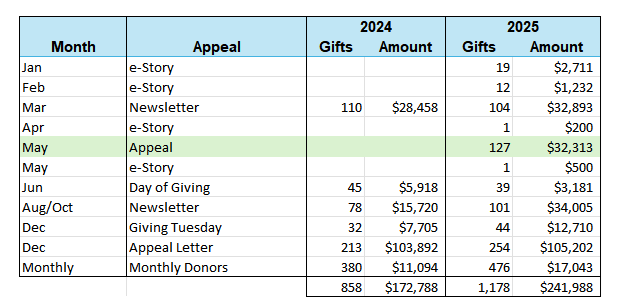
- This table of results from a food related non-profit shows that even with multiple asks during the fall, giving does not drop off-because they are doing a great job telling the stories that show how the donor's money is working.
- Increasing the number of times you mail provides more chances that your appeal will arrive when donors are ready to give.
- It also gives your committed donors the chance to give a second gift. Those who mail four times per year or more find that 20% of their donation dollars come from the 15% of donors who make second, third, and fourth gifts.
- If your appeal letters and emails thank donors, tell stories showing how gifts are used, and include testimonials, most donors will appreciate hearing from you even if they are not ready to give again at that moment.
- Important practices:
- In the appeal letter, thank donors who already gave this year, then ask them to consider another gift.
- Thank members and monthly donors for their faithful support; then ask them if they will consider a 'year-end gift', or 'gift for this project', or gift to trigger a match, etc.
- Show them you know and appreciate their giving history and help them remember when and how much they've last given, by including a reminder sentence on the reply form that says "My last gift was < $XXX > in < Month > of < Year >".
The data shows that each time they mail an appeal, the median organization has a more than 1.0 % chance of recovering donors lapsed up to 5 or 6 years.
- 1.0% doesn't sound like a lot, but every dollar spent mailing those lapsed donors will return between $1.50 and $2.00 right away.
- And the data shows that, once they come back, their renewal rate will be high.
- Every additional % of retention helps in the current environment where many organizations are watching their donor pool decline every year.
- But that appeal can't be the only time the donor has heard from you in the last year. Especially effective in keeping their attention are those donor impact emails that you should be sending every month or every two weeks.
- Test going back further at the end of calendar year. Consider which deeply lapsed donors to solicit based on evidence they are still interested, for example, do they open emails you send them?
- Photos aren't just window dressing or design features. Use color photos with captions that support or convey the story or mission delivery. Readers are scanners; captions on photos attract the eyes and get read.
- The best photos are those showing one or two people looking directly into the camera. People who need my help. People who are grateful for my help. People who will do good things with my help.
- Each image in fundraising materials should contribute to the narrative and evoke emotions, as explained in our Guide to Designing Compelling Fundraising Newsletters. For more examples of great photos see Keep your Donors Reading and How to Design and Write a Donor-centric Fundraising Letter.
- There is a not-uncommon belief that donors will only read one page - the executive director or board member who thinks that because they would only read one page that's what everyone else would do.
- The data shows that's wrong.
- Why? You need room to answer these questions in the donor's mind: What's the problem my donation will fix? Is the problem urgent? Do I care about solving that problem? Tell it to me in story format and with testimonials so I really get it. Show me a picture that hits home. Oh, and how much should I give?
- You think donors won't read your copy? Maybe that's because you wrote them a memo that puts them to sleep, not a fundraising letter that engages emotions and is story based. Read the copywriting posts in our Knowledge Center. They will improve your writing and your results.
- Beware! The more a fundraising direct mail piece looks like advertising, the less money it raises. That's why the traditional letter format raises more money than a brochure or self-mailer format. Remember, it is a conversation between you and the donor.
- If you want to motivate donors, tell stories; don't overwhelm them with graphics and color. A fundraising letter is not where your designer displays her creativity - it is where your copywriter expresses her empathy and employs her storytelling chops.
There are five "tests" to help decide whether a rental list might work for your organization.
- Your organization is well known in your (local) community or (regional/national) interest area, e.g., you are the hospital, the food bank, the school, the homeless shelter, the land trust, the primary advocacy group for prisoners, an endangered animal, a disease, etc.
- Your appeal is pressing, well defined, story-based and engages donor emotions.
- Your website shows evidence of credibility, expertise, results and responsibility; with the information that many donors need to feel comfortable about making their first gift: your track record, budget, impact, board members, testimonials, services, staff names, phone number to call, donation button, branded transaction page.
- You can identify a rental list of those more likely to support your cause (propensity to give) and filtered for capacity; for example, top 50% home value and > 45 years old.
- Your first-time donor renewal rate is 30% or more.
Even when you can meet all these criteria, you may lose money on a rental list initially. But if the renewal rate of new donors you do get is more than 30%, chances are that you will have a positive ROI in three or so years.
For an in-depth look and case study about using rental lists watch this recording of a seminar on donor acquisition I did for the Society for Legal Aid.
Your case for giving is usually compelling enough for everyone in the mailing without segmentation that may require a lot of staff effort to implement. A very engaging story line may work for everyone. Any segmentation you do implement should be simple and make a meaningful difference to the recipient.
Segmentation based on donor transaction history is the easiest segmentation to implement and most used type of segmentation. It makes slight variations in the language around the "ask" in the letter, as in these examples:
[Segment Name: PROSPECT]
P.4 [Will you consider a gift of]
P.5 [By making a gift to the museum, you invite]
P.7 [Your new gift matters now because]
[Segment Name: LEADERSHIP]
P.4 [Will you make a leadership gift of]
P.5 [Because you value the museum, you invite]
P.7 [Your generous gift matters now because]
[Segment Name: ADDITIONAL GIFT]
P.4 [Will you make an additional year end gift now of]
P.5 [Your additional gift to the museum invites]
P.7 [Your extra gift matters now because]
[Segment Name: RECURRING DONOR]
P.4 [Thank you for your faithful monthly giving. Will you consider making an additional year end gift of]
P.5 [By making a gift to the museum, you invite]
P.7 [Your extra gift matters now because]
[Segment Name: MEMBERS]
P.4 [Will you supplement your membership with a gift of]
P.5 [Your gift to the museum invites]
P.7 [Your additional support matters now because]
[Segment Name: SYBUTNT/SYBUNT]
P.4 [Please renew your gift of]
P.5 [By making a fresh gift this year to the museum, you invite]
P.7 [Your gift matters now because]
Identity or Interest segmentation can improve results but is more difficult to implement for these reasons:
- It may not be easy to correctly identify the segment to which many constituents belong. That information just isn't captured in your donor management software.
- Different stories, photos, and language for each such segment can double the staff time needed to prepare the appeal and may be hard to get.
But, here are some examples that may be easy to implement based on varying a few words or choosing different testimonials:
- Mention the town or region they live in if services are in multiple locations.
- In education, the relationship of alumni, former parents, and current parents to the school can be simple to knowledge with a few word changes.
- Minor variations can show that you recognize how their experience with your agency started: animal adopter, spay clinic donor, tribute donor, etc. But the effort to produce letters based on completely different story arcs may not be worth the usual small difference in results.
- In healthcare appeals, Cancer, Cardiac, Kids are the three main areas service that might justify segmentation in stories, testimonials, or signers; but takes more effort to implement.
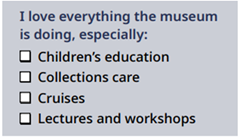
You can also provide a way for donors to express what matters to them by including some checkboxes on the reply card like this example. Gathering this type of interest segmentation may help guide future stories and testimonials.
Follow these links for further notes and examples of segmentation in the letter or on the reply card.
- There is a truism that 'people give to people'. So, the most recognizable face of the organization should usually sign the letter.
- That is usually going to be the Executive Director.
- Developing a brand for the Executive Director through these letters-as a primary storyteller for the organization-helps the ED become a personality, not just a name, and this helps build trust with donors.
- But the letter might also be from someone with great authenticity: a care giver (e.g. a nurse) or a recipient of help (e.g. a student) or a volunteer if they are the one with the story to tell. Then they might sign the letter. More likely though the story-in-their-own-words would be wrapped fore and aft by the messaging and asking of the Executive Director who is signing the letter.
- The letter should feel like a conversation between the writer and the donor. Several things that help the reader to feel that the writer is speaking directly to them are:
- Only the writer has signed the letter. It isn't from a committee!
- The signer's headshot is next to her signature, so the reader can both 'see' and 'hear' her.
- The writer uses "You" and "I" (not 'we') when writing. They are two of the 5 words you must use if you want to raise more money.
- I like to say that procrastination is the enemy of response. By that I mean that the letter has arrived, it's been scanned by the reader and set aside 'for the moment' or 'until I do the bills'. Emails help overcome this procrastination; and by giving a link or QR code to click, make giving easier. This is one reason why many donors respond on-line to direct mail appeals.
- I suggest sending two follow-up emails, about one week and about two weeks after the average in-home date of the appeal. Your copywriter should write those emails at the same time as writing the letter copy.
- Yes, include a QR code on the reply form. It reduces the effort for those who are able and willing to give via their phone. The QR code should send them to the transaction page. Examples here.
- Giving via QR codes is still a small percentage of gifts for our clients who use them. Most online gifts are made from the desktop, not the mobile phone.
- Teasers are risky. They are more likely to depress responses. They usually alert the recipient that this is an ask for money. They start the ask before the desire to give has been created by reading the letter. There are exceptions. Read more here.
- An insert, in addition to the letter, reply card and reply envelope may improve response if done well. But most non-profits have only one to three development staffers who struggle to get all the basics done. Adding another task to the struggle of getting out an appeal can mean the mailing gets delayed, the cost goes up, and perhaps some other important task gets delayed.
- Moreover, you don't probably mail the quantity needed or have the budget or time to do regular A/B testing, so you don't know if including an insert is paying for itself.
- Creating an insert for your direct mail piece should be added to your task list only after you have taken care of other essentials, like increasing your appeals per year up to three or more and your newsletters up to two or more; and you are getting out at least one donor impact email per month, and you are making your donor thank you calls. Not to mention major donor stewardship.
- I've done rental list mailings with an extra insert that performed terrible and others that exceeded expectations with only a letter and no lift cards or inserts. A longer letter and/or additional inserts probably will improve response and may be worth the extra effort and expense... but you better be mailing 5,000 or more to have reasonable cost.
- Try a "lift note", a photo card, a map or chart. Look for ways to make the topic more real or more emotional. Map style layouts and additional bio/profiles of those helped can connect with the donor and/or increase the emotional impact of the package.
- First, make sure your newsletter is not a typical newsletter!
- It should be a donor-centric impact report. The key phrase that appears more than once in your short newsletter is "because of you". The heart of it is stories about the people the donor helped.
- Think of it as a two- to six-page opportunity to give your donors an insider's view of what their money is doing and to show them that they are part of your team, all while generating additional donations.
- See the answer to the next question for the fact that your printed donor newsletter will bring in additional money.
- "Couldn't we just send emails?" NO! Both are essential. Email get 25-35% opening rates at best. But printed non-profit materials that arrive in the mail get over 75% readership - from all ages! - according to the USPS Generational Study. If you want your donors to read your newsletters, PUT THEM IN THE MAIL. Neuroscience teaches us that a newsletter you hold in your hand has much more impact than a digital newsletter. (And please, no PDF newsletters by email: not many people read PDFs attached to emails)
- Donors really do read these printed newsletters, or donor-impact reports as we like to call them-if they are donor-centric. When I was on the board of a hospital foundation, we did a series of small gatherings of donors in homes. When asked about our donor impact newsletters, almost every attendee claimed they read them, and even kept them on their coffee table.
- By the way, and this is important, here's some guidance on how to keep your newsletter design both pleasing and READABLE.
- There is an art to writing and designing these newsletters, as we explain in multiple blog posts.
- When a printed donor-centric newsletter is mailed in an outer envelope - usually a 6 x 9.5 envelope; and a reply envelope is included - either a plain #9 envelope or a #6 remit/reply or #9 remit/reply - more money comes back than it costs to print and send the newsletter. Some newsletters raise as much as an appeal! (see under question 1).
- In fact, for the donor newsletters Five Maples writes, designs, prints and mails for our clients, the average cost to raise a dollar from these newsletter mailings is 64 cents. That is, for every dollar spent on the creative, printing, mailing and postage, $1.56 comes back in those reply envelopes.
- For our clients, the average number of newsletters sent out per mailing is around 3,800. Usually, all donors in the previous three years are included.
- Newsletters continue to provide donors with stories about how their money was used. That will boost giving throughout the year.
- You could have the envelope "stitched" or "blown-in" to your donor-impact report, but normally a donor-impact report is between 2 and 8 pages 8.5 x 11". These don't lend well to that. Putting the newsletter in an envelope with the outside message "Your Donor Impact Report Is Inside" is more interesting and personal than getting a folded and tabbed newsletter that looks an awful lot like a sales circular.
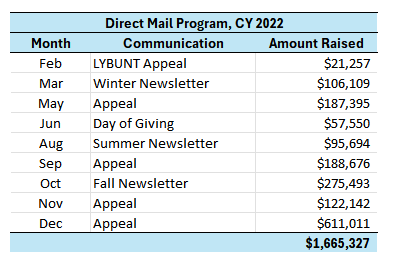
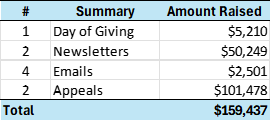
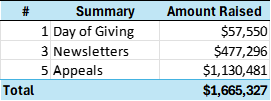
Here are examples of annual direct mail programs from two social services non-profits, one small and the other not so small, showing either two or three donor newsletters during the year. Note how much additional income the newsletters add. For most non-profits who have very limited staff, two to three newsletters per year is a reasonable goal.
- Many donors like to have a choice on where their money is spent; it gives them more agency. Three or four choices plus "Where needed most" should be the limit. Too many choices interfere with decision making. Here are links to examples: Conservation Organization. Education Organization. Hospital.
- If a donor checks a designated use, that gift becomes restricted to that use. Be sure the choices you offer are for uses for which the expenditures far exceed the potential restricted funds.
- Don't create choices just to have them. They need to be meaningful. For example, a family may be more likely to support the cancer center or hospice depending on what area of service they experienced.
- An alternative is a list of "What your gift can do" items without checkboxes so that no designation is made by the donor. Here are links to some examples that show how to do it without implying a restriction of funds to that use when giving one of the mentioned amounts. Humane Society. Community Kitchen. Homeless Shelter. Advocacy Organization.
- Another approach may be to give the donor the opportunity to express their interest, rather than designating their money, as shown here: Museum.
- Yes. Donors who already gave this year, even those who have given within the last couple of months, are some of the best prospects for an additional gift.
- Our data shows that the median response rate to a mailing of donors who already gave this year is 7.2% - only slightly less are the LYBUNTS at 9.6%. If you don't ask for additional gifts in the same year, you are missing up to 20% additional income.
- In the last few years food service, taxis, the local grocery co-op, and other service heavy sectors are all giving customers a tip suggestion based on a set of three choices. Why? Because it lifts tip amounts by making the decision easy.
- The same psychology of asking the donor for a specific amount, usually a stretch amount, works in major giving and in direct mail, as we discuss in a series of blog posts, beginning with Why Anchoring Improves Your Average Donation. Asking for a specific amount in the letter gets the anchoring process started.
- We advise including the middle amount in the ask string on the reply form as the amount to ask in the letter. The middle amount of the ask string is the next higher likely amount that donors use.
- For example, if the donors' last gift was $25, the ask string on the reply card will be $100, $50, $25 and the ask amount in the letter will be $50, as explained in our downloadable guide How Ask Strings Work.
- Use a separate reply card. Remit envelopes are static print pieces, so you can't include gift boosting features like a reminder of the donor's last gift, a suggested ask string, checkboxes to indicate the donors giving over the last 4 - 6 years or asking the donor to update their (printed) email or phone information.
- Remit envelopes require the donor to do the work of writing in their name and address. The more work, the more potential for procrastination. Pre-populate that information for the donor on the reply card.
- When to use a remit envelope? Always include one as a soft ask with your newsletters/donor impact reports/annual reports.
- Yes. Their gift response is more likely to be online, but they do open and read direct mail and respond to it, across all sectors of marketing, including fundraising, as documented by the USPS Generations study.
- Getting the letter opened is not what you should worry about because more than 75% of mail from non-profits is read, even by Millennials, as documented in the USPS's Generations Study.
- Calendar year-end letters perform best, followed by spring and fall appeals. Also, plan ahead for mission-driven dates or campaigns tied to fiscal goals.
- Response to End of Year letters appear to perform equally well whether they arrive in November or early December. We recommend that such letters arrive prior to the start of Hannukah or no later than the weekend before Christmas. After that response may decline, but emails arriving up to the end of the year, even on New Year's Eve, have shown a good response.
- Letters that arrive in the first couple of weeks of January have performed poorly.
- While there is hesitation from fundraisers around letters arriving in the summer, we have good results even from letters arriving in July.
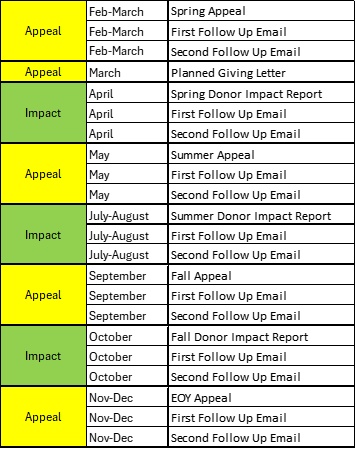
- Here's our recommended schedule for a robust year of direct mail fundraising.
- Personalize them, write in a conversational tone, lead with impact, and use short, readable paragraphs. We have many helpful posts and examples at our Knowledge Center and our Design pages.
- Segment your list, personalize content, tell compelling stories, and use donor-focused language. Clear calls to action are key.
- Your stewardship process has a huge influence on response rates. Send a thankyou letter, send a thank you email in addition to the gift acknowledgement email, make a thank you call, send bi-weekly donor impact emails, send a printed donor impact report or postcard before the next appeal. Failure to renew donors is a failure to communicate.
- Invite donors to events, to meet the ED, to visit the facility, to have tea with the development manager.
- Add hand-written notes to the letters you send to major donors, donors with capacity, and donors acquainted with board or staff.
- Keep sending donor impact emails no matter how deeply lapsed; let them make the decision whether to unsubscribe.
- Keep sending appeals to donors until they are lapsed more than six years. Here's the data to back this up: what you get back is more than what you spend on the appeal mailing. And once they come back, their future renewal rate and value is high.
- We recommend sending your donor-centric newsletters to every donor lapsed not more than three years; keep them in the loop, keep them informed; keep telling your story. It is surprising how many come back after being gone for three years.
- Thank you phone calls are a powerful way to keep donors from lapsing. I've made many such calls; every person I thanked has been grateful for the call and told me how important the organization's work is. That creates a consistency bias in the donor that motivates future giving. "I've told them how important their work is; I've now got another appeal; I'll back up my words with another donation."
- Personalized thank you cards have the same effect for many donors. They are often saved and treasured.
- My observation is that the biggest missed stewardship opportunity for most small non-profits is not sending frequent email updates, stories, testimonials, and accomplishments.
- How frequently? Every two weeks would be great. That's by no means too often. For most organizations it would be a challenge to gather the information and write the copy to send emails that frequently. But there is no excuse for not emailing at least monthly.
- Open rates by donors for such emails are in the 25% to 35% range. That's 5 times the average open rates that for-profit marketers get.
- Why? Because your donors think of themselves as investors in your organization. Their return on investment is not a product or service or an interest rate payment. It's about knowing they are a good person helping others and doing good in the world. Your newsletters and emails, thank you notes and thank you calls, are what lets them know they are putting their money in the right place!
- First class does not raise more money in-and-of itself.
- But one reason to use first class is to be sure your mailer gets there either in a specific window of time or before a deadline. Some examples of when the timing matters:
- You might have fallen behind schedule and need the 3-5-day delivery first class provides;
- Your end of year appeal needs to be there either before the start of Hannukah or before the weekend before Christmas day;
- Your day-of-giving mailer, event announcement, or reunion message mailer obviously needs to hit before those events;
- But the best reason to use first class is because you are adding hand-written notes to the appeal letter. Those notes boost response. The USPS requires anything with live handwriting, on it or in it, mail with a first-class Forever stamp.

Written by:
Gary Henricksen the Human.
No part of this article was written by AI.